Bluetti AC180 vs EcoFlow Delta 2 — Detailed Comparison (2026)
Bluetti AC180 vs EcoFlow Delta 2 — Full Comparison
If you're shopping for a mid-range portable power station in 2026, two models keep coming up: the Bluetti AC180 and the EcoFlow Delta 2. Both sit in the 1–2kWh sweet spot — enough to keep a refrigerator running through an outage, power a CPAP machine for multiple nights, or serve as weekend camping power. Both use LiFePO4 battery chemistry (3,000+ cycles). Both charge from 0–80% in about an hour.
But they are not the same machine. They diverge meaningfully on expandability, weight, solar input, app features, and the little design details that matter after months of ownership.
We reviewed both units across eight critical dimensions — capacity, charging speed, expansion options, portability, solar compatibility, noise levels, app experience, and real-world reliability — to give you a clear answer.
Here's the short version: EcoFlow Delta 2 wins on ecosystem polish and faster AC charging, while Bluetti AC180 wins on expansion potential and cold-weather charging. Your choice depends on whether you prioritize a sleek smart-home experience or future-proof capacity scaling.
🥇 EcoFlow Delta 2 — Best Overall for Most Homes
Specs: 1024Wh | 1800W continuous / 2700W surge | LiFePO4 | 27 lbs (12 kg) | $999

The EcoFlow Delta 2 is the most polished mid-range power station on the market. Its 1024Wh capacity and 1800W continuous output handle virtually every apartment need: a refrigerator (600–800W startup), modem/router (10–20W), LED lights (10–30W), CPAP (30–60W), plus phones and laptops.
What really sets the Delta 2 apart is charging speed. It goes 0–80% in just 50 minutes on AC — the fastest in its class. In a rolling blackout scenario where grid power comes and goes, that means you can top up during brief windows and still have power through the night.
The EcoFlow app is the best in the industry. Real-time wattage tracking, estimated runtime, custom charge limits, and firmware updates over WiFi. The UPS mode switches in under 10ms — fast enough for sensitive electronics like gaming PCs and network equipment. And the expansion battery (DB2000, +2048Wh, $699) brings total capacity to nearly 3kWh when you need more.
Downside: the Delta 2 uses a relatively compact 1024Wh base capacity. If you need more than 1kWh out of the box, you'll have to invest in the expansion battery, which pushes the total cost past $1,600.
🥈 Bluetti AC180 — Best Expandable Option
Specs: 1152Wh | 1800W continuous / 3600W surge | LiFePO4 | 37 lbs (16.8 kg) | $799
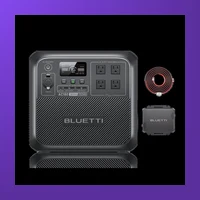
The Bluetti AC180 starts with a larger base capacity — 1152Wh vs 1024Wh — at a lower price point. That's already a meaningful advantage: about 12% more runtime before accounting for any expansion. At $799, it's $200 cheaper than the EcoFlow Delta 2 with more usable energy out of the box.
But the real differentiator is expansion flexibility. The AC180 supports the B180 expansion battery (+1800Wh, $549), bringing total capacity to nearly 3kWh — comparable to the Delta 2's expanded setup but at a lower combined cost ($799 + $549 = $1,348 vs $999 + $699 = $1,698).
The AC180 also handles high-surge loads better, with a 3600W surge capacity compared to the Delta 2's 2700W. This matters if you need to start a well pump or a larger refrigerator compressor. The 500W solar input is on par with the Delta 2's 500W, and the Bluetti app provides solid monitoring and control features.
Downside: the AC180 weighs 37 lbs — 10 lbs heavier than the Delta 2 — making it noticeably less portable. And its AC charging, while fast at 0–80% in 1 hour, is still 10 minutes behind the Delta 2.
Side-by-Side Spec Comparison
| Spec | EcoFlow Delta 2 | Bluetti AC180 |
|---|---|---|
| Capacity | 1024Wh | 1152Wh |
| Continuous Output | 1800W | 1800W |
| Surge Output | 2700W | 3600W |
| Battery Type | LiFePO4 | LiFePO4 |
| Cycle Life | 3000 cycles | 3000+ cycles |
| AC Charging (0–80%) | 50 min | 60 min |
| AC Charging (0–100%) | 1.2h | 1.5h |
| Solar Input Max | 500W | 500W |
| Expansion Battery | DB2000 (+2048Wh, $699) | B180 (+1800Wh, $549) |
| Weight | 27 lbs (12 kg) | 37 lbs (16.8 kg) |
| UPS Switch Time | <10ms | <20ms |
| App | EcoFlow (best in class) | Bluetti (solid) |
| Warranty | 5 years | 5 years |
| Price (MSRP) | $999 | $799 |
| Expandable Total | ~3072Wh ($1,698) | ~2952Wh ($1,348) |
Charging Speed — Where Every Minute Counts
In a blackout, charging speed isn't a convenience — it's a necessity. Both units charge fast, but the Delta 2 has a clear edge.
The EcoFlow Delta 2 hits 0–80% in 50 minutes and 0–100% in 1.2 hours. That's the fastest AC charging in its class. If grid power is intermittent — say, 2 hours on, 4 hours off — the Delta 2 can fully recharge in one on-cycle and be ready for the next off-cycle.
The Bluetti AC180 is no slouch either, hitting 0–80% in 60 minutes and 0–100% in 1.5 hours. The extra 10 minutes to 80% and 18 minutes to full aren't dramatic differences, but they compound across multiple charge cycles during extended outages.
Both units support solar charging at up to 500W max input, which means 0–100% in roughly 2.5–3.5 hours of peak sun with adequate panels. In practical terms, both can recharge from empty to full within a single good solar window on a sunny day.
Expansion & Future-Proofing
This is where the decision gets interesting. Both units support expansion batteries, but the economics and approach differ.
The EcoFlow Delta 2 pairs with the DB2000 battery (+2048Wh, $699). The DB2000 brings the total to about 3kWh — roughly doubling runtime. The expansion battery is a stackable unit that connects via a thick cable, and it integrates seamlessly with the EcoFlow app. Total cost: $1,698 for ~3kWh.
The Bluetti AC180 pairs with the B180 expansion battery (+1800Wh, $549). The total lands at about 2,952Wh — comparable to the Delta 2's expanded setup — but at a total cost of $1,348. That's $350 less for similar total capacity. The B180 also connects cleanly and is managed through the Bluetti app.
Key difference: The Delta 2's base unit is more expensive but the expansion adds more capacity per dollar. The AC180's base unit is cheaper and the expansion is also cheaper, making it the more affordable path to the 3kWh range. If you're budget-conscious and know you'll expand, the AC180 is the smarter buy.
Portability & Weight
If you need to move your power station between rooms or take it camping, weight matters.
The EcoFlow Delta 2 at 27 lbs is the more portable option. It has a built-in handle that's comfortable to carry, and the weight is manageable for most adults to move from the living room to the bedroom or out to the car for a camping trip.
The Bluetti AC180 at 37 lbs is a full 10 lbs heavier. That's the difference between one-hand carry and two-hand. It's still movable, but you'll think twice before relocating it frequently. For permanent home placement (e.g., near your breaker panel or in a closet), the weight isn't an issue. But if you plan to bring it camping or move it between floors, the Delta 2 is the better choice.
App Ecosystem & Smart Features
The app experience is where EcoFlow clearly leads. The EcoFlow app offers real-time power flow visualization (see exactly how many watts are coming in from solar vs going out to appliances), estimated runtime remaining based on current load, custom charge/discharge thresholds, and firmware updates over WiFi. The interface is polished, responsive, and updated regularly.
The Bluetti app covers the essentials — charge monitoring, output tracking, and basic settings — but with a simpler interface. It's functional and reliable but lacks the data visualization depth of the EcoFlow app. For most users, the Bluetti app is sufficient. For data enthusiasts who want to geek out on energy consumption patterns, the EcoFlow app is noticeably better.
Both support WiFi and Bluetooth connectivity. Both support remote monitoring. Neither requires a subscription.
Durability & Build Quality
Both units feel solidly built. The EcoFlow Delta 2 has a slightly more premium feel with its matte finish and tight panel gaps. The Bluetti AC180 is more utilitarian — fewer aesthetic refinements but no functional weaknesses.
The Bluetti AC180 has an edge in cold-weather charging. Its LiFePO4 cells support charging down to -4°F (-20°C) — useful if you keep your power station in an unheated garage or shed during winter. The EcoFlow Delta 2 can charge down to 14°F (-10°C), which covers most scenarios but not extreme cold. If your unit lives in a freezing environment, the AC180 is the safer bet.
Final Verdict
Choose the EcoFlow Delta 2 if: You want the fastest AC charging (50 min to 80%), a best-in-class app experience, lighter weight for portability, and the cleanest ecosystem integration. It's the better all-around unit for most apartment dwellers and home backup users who value polish and speed.
Choose the Bluetti AC180 if: You want more base capacity for less money ($799 for 1152Wh vs $999 for 1024Wh), better cold-weather charging performance (-4°F vs 14°F), and a more affordable expansion path to 3kWh total. It's the better value play and the smarter choice for budget-conscious buyers or those in cold climates.
Both are excellent power stations backed by 5-year warranties and LiFePO4 batteries that will last 8–10 years with regular use. The choice between them comes down to whether you value polish and speed (Delta 2) or value and cold tolerance (AC180).
Advanced Considerations — What the Spec Sheet Doesn't Tell You
The specs on the box tell you capacity and wattage. Here's what matters for long-term ownership — battery degradation, expansion paths, and real-world gotchas that only become apparent after months of use.
Advanced: EcoFlow Delta 2 — What to Know Beyond the Spec Sheet
- Battery longevity: 3000 cycles to 80% capacity (LiFePO4). With daily use, this translates to 8-10 years before noticeable degradation. For weekly backup or emergency-only use, the battery will last even longer than the listed cycle count suggests.
- Expansion options: Supports extra battery (DB2000, +2048Wh, $699). This matters if your power needs grow over time — you can add capacity without replacing the entire unit.
- Warranty: 5 years. No registration required — coverage starts from date of purchase.
- Temperature performance: 14°F to 113°F (-10°C to 45°C) charging. Can charge in below-freezing temperatures (down to 14°F), giving it an edge for winter emergency use.
- Solar recharging speed: With the max solar input of 500W panels, you can recharge from empty to full in 4-8 hours of direct sunlight — useful for multi-day outages without grid power.
- Weight consideration: At 27 lbs (12 kg), this is manageable for most adults to move between rooms.
Advanced: Bluetti AC180 — What to Know Beyond the Spec Sheet
- Battery longevity: 3000+ cycles to 80% capacity (LiFePO4). With daily use, this translates to 8-10 years before noticeable degradation. For weekly backup or emergency-only use, the battery will last even longer than the listed cycle count suggests.
- Expansion options: Supports B180 expansion (+1800Wh, $549). This matters if your power needs grow over time — you can add capacity without replacing the entire unit.
- Warranty: 5 years. No registration required — coverage starts from date of purchase.
- Temperature performance: -4°F to 104°F (-20°C to 40°C) charging. Can charge in below-freezing temperatures (down to -4°F), giving it an edge for winter emergency use.
- Solar recharging speed: With the max solar input of 500W panels, you can recharge from empty to full in 4-8 hours of direct sunlight — useful for multi-day outages without grid power.
- Weight consideration: At 37 lbs (16.8 kg), this is on the heavier side — consider keeping it on a rolling cart or in its final location.
Frequently Asked Questions
Which has more capacity, the Bluetti AC180 or EcoFlow Delta 2?
The Bluetti AC180 has 1152Wh base capacity compared to the EcoFlow Delta 2's 1024Wh — about 12% more out of the box. With expansion batteries, both can reach approximately 3kWh total.
Can the Bluetti AC180 power a refrigerator?
Yes. With 1800W continuous output, the AC180 can handle startup surges up to 3600W. Most refrigerators draw 600–800W on startup and 150–200W running. The AC180 can run a full-size refrigerator for 6–10 hours depending on efficiency and ambient temperature.
Can the EcoFlow Delta 2 be used as a UPS?
Yes, with a switch time under 10ms. This is fast enough for most sensitive electronics including computers, network equipment, and gaming consoles. It's one of the fastest UPS switch times in its class.
Which is better for cold weather?
The Bluetti AC180 supports charging down to -4°F (-20°C), while the EcoFlow Delta 2 supports charging down to 14°F (-10°C). For unheated garages or winter camping, the AC180 is the better choice.
Do I need to register the warranty?
Both offer 5-year warranties. EcoFlow's warranty activates automatically from the date of purchase — no registration needed. Bluetti's warranty also activates at purchase with no registration required, but it's good practice to keep your receipt.
Ready to buy? Check the latest prices on Amazon: